
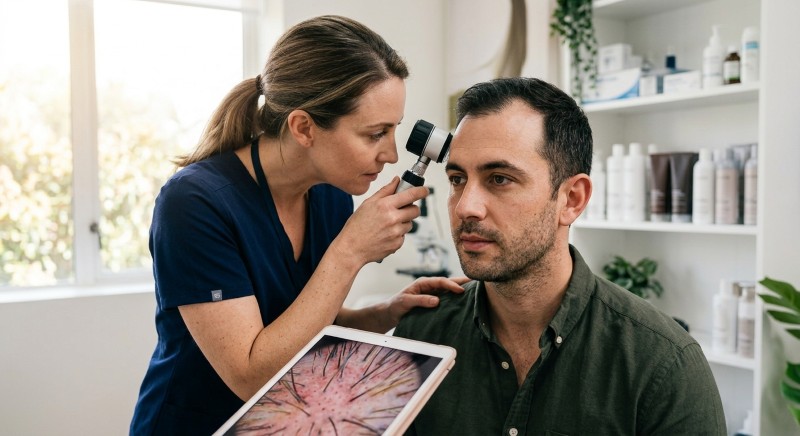
“Why is my hair falling out?” is one of the most common questions we hear, and the honest answer is that it depends. Hair loss isn’t one condition with one cause, it’s a symptom that can come from genetics, hormones, stress, illness, or how you treat your hair day to day. Knowing which one applies to you is what makes a treatment plan actually work instead of guessing.
Androgenetic alopecia, better known as male or female pattern hair loss, accounts for the majority of hair loss cases. It’s driven by a genetic sensitivity to DHT, a hormone that gradually shrinks affected follicles over successive growth cycles until they stop producing hair.
This type follows a fairly predictable pattern, receding at the temples and crown in men, diffuse thinning along the part in women, which is exactly what the hair loss stages guide walks through in more detail. Genetic hair loss doesn’t skip a generation or come only from one side of the family, despite the popular myth, and it can start as early as your twenties.
Hormones influence hair growth far beyond pattern baldness. Pregnancy, postpartum shifts, menopause, and thyroid conditions can all trigger noticeable shedding, sometimes months after the hormonal change itself.
Thyroid-related hair loss in particular is easy to miss because the shedding often looks diffuse rather than patterned, and it’s frequently mistaken for pattern hair loss until bloodwork tells a different story. We’ve covered this in more depth in our piece on hair loss and hypothyroidism, since it’s one of the more commonly missed causes we see in consultations.
A stressful period, whether physical (illness, surgery, extreme dieting) or emotional, can push a large number of follicles into their resting phase at once. Around two to three months later, that shows up as a sudden increase in shedding, a condition called telogen effluvium.
The good news is this type is usually temporary. Once the trigger passes, most follicles resume normal growth on their own within several months, though the shedding itself can be alarming while it’s happening. Our article on stress, environment and sudden shedding covers how to tell this apart from a more permanent form of hair loss.
Hair follicles are metabolically demanding, and a shortage of iron, protein, vitamin D, zinc, or B vitamins can slow growth or increase shedding. This is more common than people expect, particularly with restrictive diets, and it’s rarely the only cause at play, more often a contributing factor sitting alongside something else.
Fixing a deficiency won’t undo genetic hair loss, but it removes one variable that could otherwise be making things worse than they need to be.
Some hair loss has nothing to do with genetics or hormones directly. Autoimmune conditions like alopecia areata cause the immune system to attack hair follicles, producing patchy or, in more severe cases, more widespread loss. We go into this in detail in our post on hair loss and autoimmunity.
Certain medications, chronic illnesses, and treatments such as chemotherapy can also cause hair loss as a side effect rather than a standalone condition, which is why an accurate history matters as much as examining the scalp itself.
Tight hairstyles, chemical treatments, heat styling, and some hair products can cause a mechanical form of hair loss called traction alopecia, or general damage that weakens strands over time. This tends to affect specific areas first, most often the hairline and temples, depending on how the hair is styled.
Unlike genetic hair loss, this type is often preventable simply by changing the habit before permanent follicle damage sets in.
Hair naturally thins with age, even without pattern baldness in the picture. Growth cycles slow, individual strands become finer, and density gradually decreases. It’s a separate process from androgenetic alopecia, though the two frequently overlap, which is why age-related thinning sometimes gets misread as something more treatable than it is. Our post on hair loss with ageing covers what’s realistic to expect and what isn’t.
Two people can have identical-looking thinning and completely different causes behind it, which is exactly why treating the symptom without identifying the cause so often disappoints. A supplement won’t fix genetic hair loss, and a hair transplant won’t fix a thyroid issue.
At HDA Clinic in Fourways, every consultation starts with a proper history and scalp assessment before any treatment is recommended, so the plan actually matches what’s driving your hair loss rather than what worked for someone else. If you’re also unsure what your hair loss actually looks like day to day, our guide on signs of unhealthy hair is a useful starting point.
If you want a proper answer instead of another guess, book a consultation and we’ll work through your history and scalp together.
No. Genetics is the most common cause, but hormonal changes, stress, medical conditions, nutritional deficiencies, and styling habits can all cause hair loss independently of family history.
In most cases, yes. Stress-related shedding, known as telogen effluvium, is usually temporary and resolves within several months once the underlying trigger is addressed, as long as there isn’t a separate condition also at play.
Hormonal hair loss often shows up as diffuse thinning rather than a defined pattern, and it may coincide with other symptoms like fatigue, weight changes, or irregular cycles. Bloodwork alongside a scalp assessment is the reliable way to confirm it.
A significant nutritional deficiency can cause or worsen shedding, but it’s rarely the sole cause. It’s more commonly a contributing factor that sits alongside a genetic or hormonal issue.
HDA Clinic is based at 25 Chrisoliet Street, Jukskei Park, Fourways, Johannesburg, 2188. You can book a consultation by calling +27 73 536 7845 or +27 65 628 8650, emailing info@hdaclinic.co.za, or requesting a personalised treatment plan online.