
Not every hair problem is hair loss. Sometimes what’s bothering you is dryness, breakage, or hair that just doesn’t look or feel the way it used to, even if the amount on your head hasn’t changed much. Knowing the difference matters, because unhealthy hair and hair loss don’t always need the same fix.
Losing 50 to 100 hairs a day is normal, part of the ordinary growth cycle rather than a problem. What’s worth paying attention to is a clear increase from your own baseline, noticeably more hair in the shower drain, on your pillow, or caught in a brush than you’re used to seeing.
If that increase is sudden rather than gradual, it’s more likely linked to an underlying cause than to hair health on its own. Our guide on the main causes of hair loss breaks down what tends to drive that kind of shift.
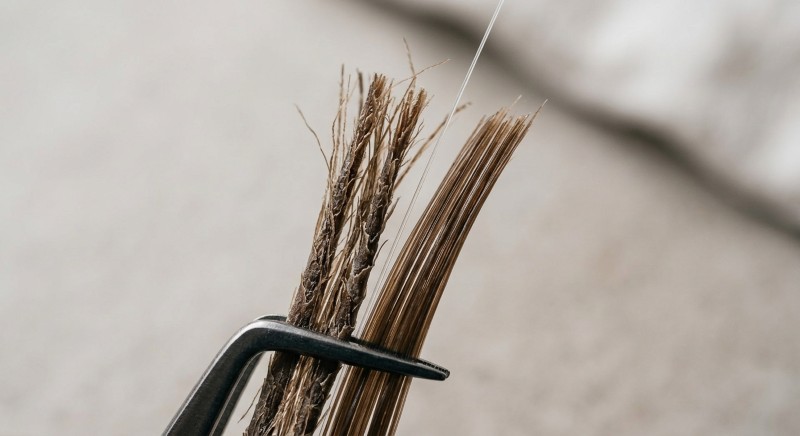
Healthy hair has a natural sheen and some give to it when stretched gently. Unhealthy hair tends to feel rough or straw-like, snaps rather than stretches, and develops split ends further up the shaft than usual, not just at the very tips.
This is usually a sign of damage to the hair shaft itself, from heat styling, chemical treatments, sun exposure, or simply not enough moisture, rather than a problem with the follicle underneath.
There’s a difference between fewer hairs and thinner hairs. If your ponytail feels noticeably less dense than it used to, or individual strands feel finer even though you’re not seeing more shedding, that points to strand health or early follicle miniaturisation rather than active loss.
It’s worth checking this against the stages of hair loss, since early miniaturisation can look and feel a lot like general hair thinning before it becomes obvious as pattern loss.
Hair health starts at the scalp, and a flaky, itchy, or tender scalp is often the first sign that something’s off, sometimes before it affects the visible hair at all. Persistent flaking that isn’t ordinary dandruff, redness, or a scalp that feels sore to the touch can point to conditions ranging from seborrheic dermatitis to product buildup to a more active inflammatory issue.
Ignoring scalp symptoms tends to make things worse over time, since an unhealthy scalp environment makes it harder for follicles to function normally.
Hair that’s lost its natural shine, looks dull even after washing, or has changed texture, curlier, frizzier, or coarser than it used to be, is showing signs of cuticle damage. The outer cuticle layer normally lies flat and reflects light; when it’s roughened by heat, chemicals, or friction, hair looks duller and feels rougher no matter how it’s styled.
This kind of damage is cumulative. A single bad styling session rarely causes lasting change, but repeated heat and chemical exposure without enough recovery time between them does.
Hair that seems stuck at the same length for months, even though you’re not cutting it, can be a sign that strands are breaking off as fast as they grow, rather than growth actually slowing down. This is one of the more commonly missed signs, since it’s easy to assume “my hair just doesn’t grow” when the real issue is breakage cancelling out growth.
Occasional dryness or a bad styling week isn’t cause for concern. But when several of these signs show up together, and especially if they’re paired with visible thinning, it’s worth getting the scalp and follicles properly assessed rather than just switching shampoos.
At HDA Clinic in Fourways, our trichologists examine the scalp and hair shaft directly, which is the only reliable way to tell whether you’re dealing with surface damage, a scalp condition, or the early stages of hair loss that happens to look like general hair health issues at first. Non-surgical treatments like scalp microneedling and mesotherapy can address both strand health and follicle function, depending on what’s actually going on underneath.
Most people try to fix unhealthy hair with a new product before finding out what’s actually causing it, which is why the same issue often comes back a few months later. A proper assessment tells you whether you’re dealing with damage that grows out on its own, a scalp condition that needs treating, or something tied to the causes of hair loss that’s worth catching early.
If you’re not sure which of these applies to you, book a consultation and we’ll take a proper look before recommending anything.
Damage usually affects the hair shaft itself, dryness, split ends, dullness, and tends to improve with better care and trims. Unhealthy hair tied to an underlying cause often comes with scalp symptoms or thinning that a change in products won’t fix.
Not necessarily. You can have healthy, strong strands and still be losing hair due to genetics or hormones, just as you can have unhealthy, damaged hair with no actual hair loss happening underneath.
Surface damage like dryness and split ends generally grows out with proper care over time. Issues linked to the scalp or follicle function usually need a targeted treatment plan rather than product changes alone.
Common causes include dandruff, product buildup, dryness, and inflammatory scalp conditions. Persistent or worsening symptoms are worth having assessed rather than treated with over-the-counter shampoos indefinitely.
HDA Clinic is based at 25 Chrisoliet Street, Jukskei Park, Fourways, Johannesburg, 2188. You can book a consultation by calling +27 73 536 7845 or +27 65 628 8650, emailing info@hdaclinic.co.za, or requesting a personalised treatment plan online.