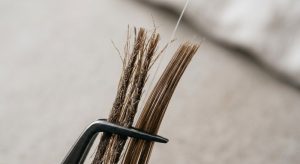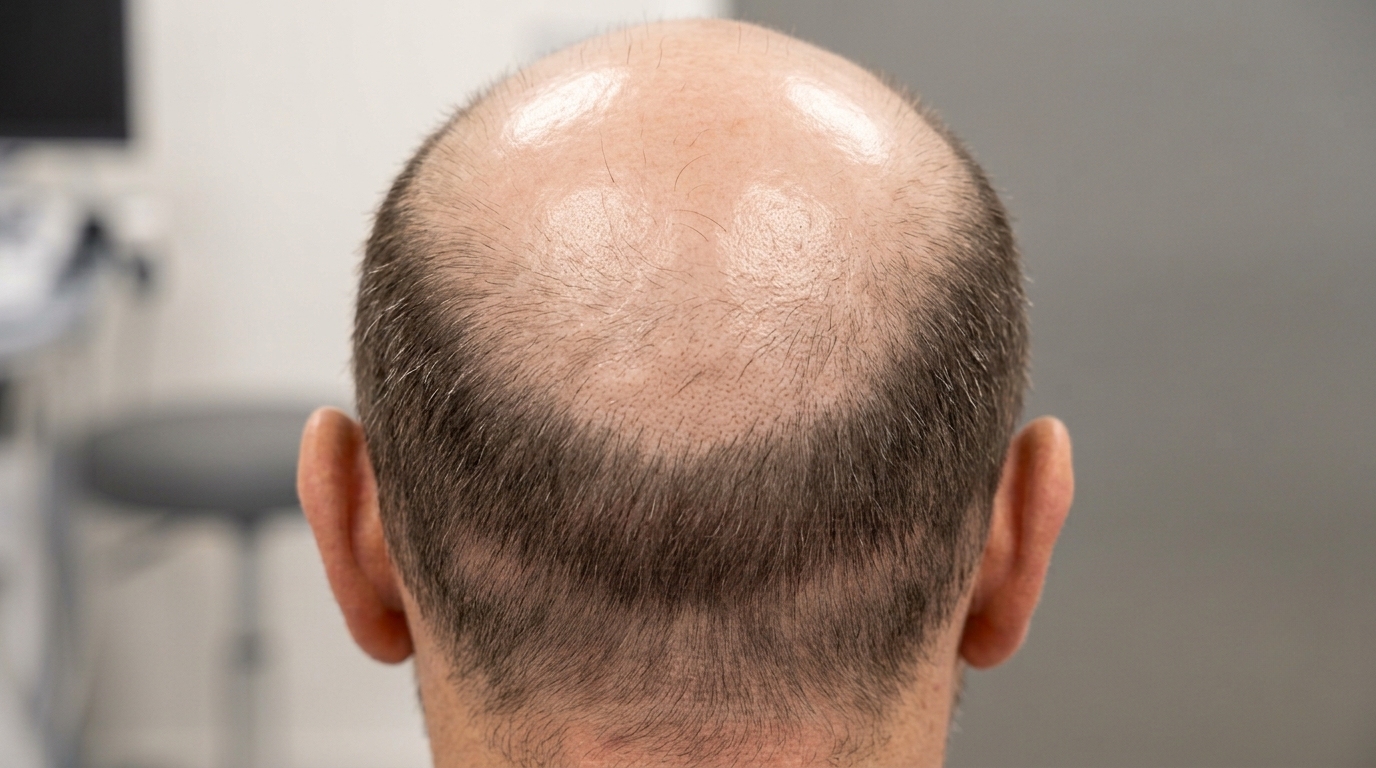
Your donor area, the strip of hair at the back and sides of your head, is where every graft in a hair transplant comes from. If that hair is thin, sparse, or weak, no amount of surgical skill can turn it into a full, dense result. This is the single biggest reason patients end up disappointed with a transplant, and it’s rarely explained properly before the procedure.
Hair at the back and sides of the scalp is genetically resistant to the hormone that causes pattern baldness, which is why it keeps growing for life regardless of where it’s moved to. That’s the entire principle a hair transplant relies on: take permanent hair from the donor zone and relocate it to where hair has thinned or stopped growing.
But that only works if there’s enough good-quality hair to take in the first place. Density, hair shaft thickness, and how healthy the follicles are all decide how many usable grafts a surgeon can safely harvest, and how much coverage those grafts can realistically give the front and top of the scalp.
This is where a lot of clinics get it wrong, and where cheaper options often cut corners. If a patient’s donor hair is thin or patchy and a clinic transplants from it anyway, without addressing that first, the result is thin coverage spread over a large area rather than genuine density. It can look like a light dusting of hair rather than a proper hairline.
Worse, the donor area itself gets weaker every time it’s harvested from. A clinic that transplants from a poor donor zone without preparing it properly often leaves the patient needing a second transplant later, at extra cost, with even less donor hair available to work with the second time round.
This is exactly the trap surgical hair transplants are meant to avoid, and it’s why the donor area deserves as much attention as the hairline design itself.
When a patient’s donor hair isn’t strong enough to work with straight away, we don’t proceed with the transplant regardless. The donor area gets treated first, using non-surgical options like PRP, mesotherapy, or carboxy therapy to improve density, thickness, and follicle health before a single graft is taken.
That process usually takes one to two months. It’s an extra step most patients don’t expect, and one a lot of clinics skip because it adds time before the procedure they’re actually being paid for. But a donor area that’s been properly strengthened gives noticeably better yield per graft and a more even, natural-looking result once the transplant is done.
[Image: before/after comparison of a treated donor area at 8 weeks — alt: “Donor hair density before and after non-surgical strengthening treatment”]
A proper consultation should include an honest assessment of your donor area, not just a quote for how many grafts you need up front. Ask directly whether your donor hair is strong enough for the coverage you’re hoping for, and what happens if it isn’t.
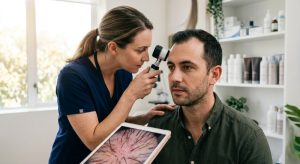
At HDA Clinic, every consultation starts with exactly that: a hands-on assessment of donor density and hair quality, using a scalp camera where needed, before any treatment plan or pricing is discussed. If your donor hair needs work first, we’ll say so, rather than harvesting what’s there and hoping for the best.
[Image: scalp camera assessment of the donor zone during a consultation — alt: “Scalp camera assessment of donor hair quality at HDA Clinic”]
Patients researching hair transplants tend to focus on which technique to pick, Sapphire FUE versus DHI, when the donor area is what actually sets the ceiling on the outcome either way. A skilled surgeon using the right technique on a poorly prepared donor area will still produce a thinner result than the same surgeon working with a strong one.
This is also why transplant results vary so much between clinics quoting similar prices. A cheaper quote that skips donor assessment, or harvests regardless of donor quality, is often cheaper for a reason. The saving shows up later as a patchy result and, frequently, the cost of a second procedure.
A transplant is meant to be a once-off investment in a permanent result, not the first of two procedures. That only holds true if the donor area is treated as the foundation it actually is, assessed honestly, strengthened where needed, and harvested in a way that protects what’s left for the future.
If you’re considering a hair transplant and want to know where your donor hair actually stands, book a consultation and we’ll assess it properly before recommending anything.
It depends on how thin. Mild thinning can often be strengthened with non-surgical treatment over several weeks before a transplant proceeds. Very limited donor hair may mean a smaller, more conservative transplant plan, or non-surgical options instead of surgery.
At HDA Clinic, this typically takes one to two months of targeted non-surgical treatment, depending on the starting condition of the donor area. Progress is checked before the transplant is scheduled.
This usually happens when grafts are taken from a donor area that wasn’t dense or healthy enough to begin with, spreading limited hair too thinly across the treated area instead of achieving real coverage.
Harvesting reduces donor density, which is why the number of grafts taken is planned carefully around what the donor area can sustain. This is also why weak donor areas need to be protected and strengthened rather than over-harvested.
A consultation including a full assessment of your donor area and hair loss pattern needs to be done. From there, a personalised treatment plan and pricing are discussed based on your specific case.
HDA Clinic is based at 25 Chrisoliet St, Jukskei Park, Fourways. You can book a consultation by calling 067 691 2721, emailing info@hdaclinic.co.za, or requesting a personalised treatment plan online.